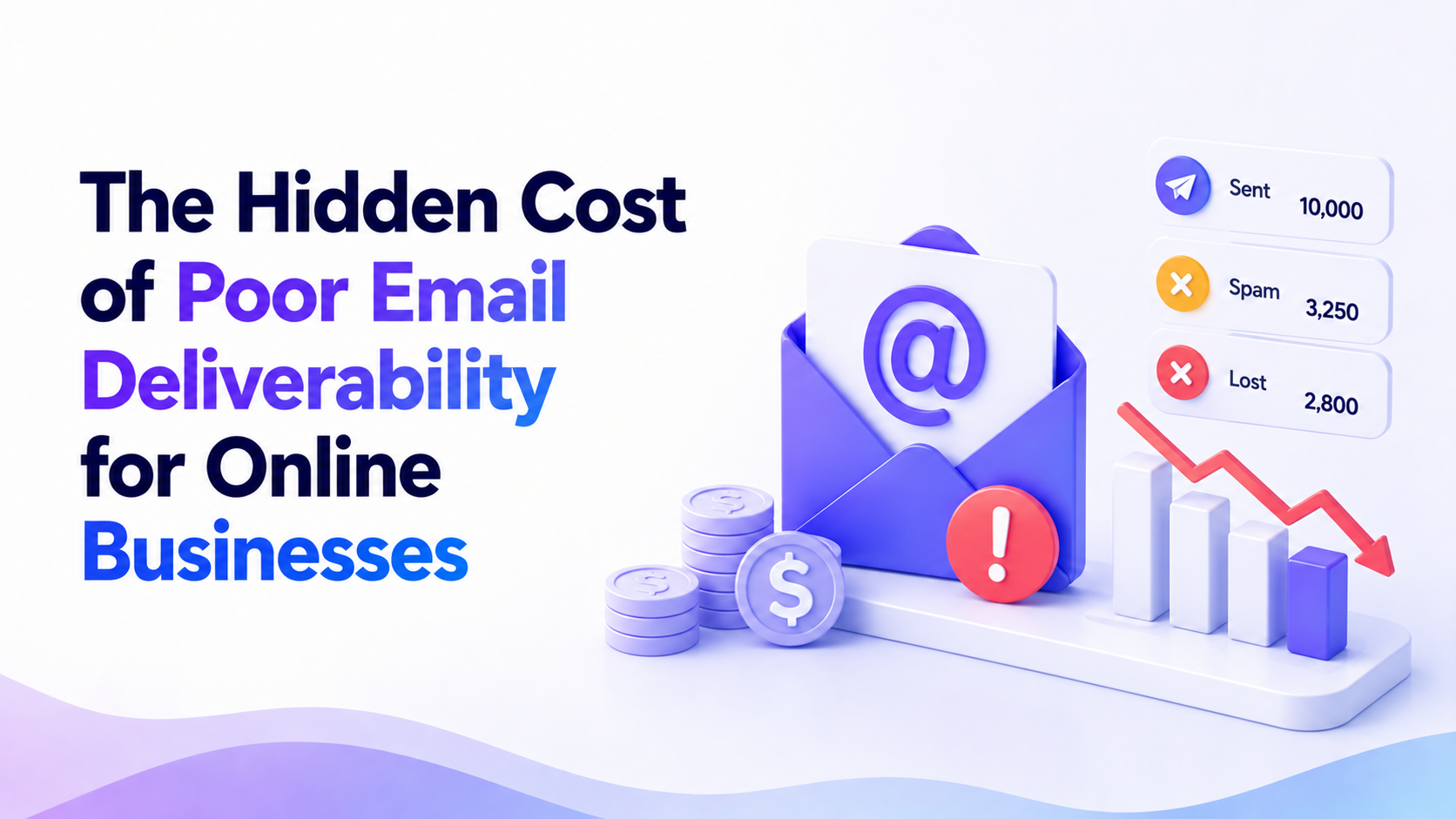
Most businesses understand the importance of email marketing, customer notifications, and transactional communications. However, many overlook a critical factor that directly impacts revenue, customer satisfaction, and operational efficiency:
Email Deliverability.
You may spend significant resources attracting customers, generating leads, and building an online presence. But if your emails fail to reach the inbox, those efforts can be undermined without you even realizing it.
The reality is simple: an email that never reaches its recipient has zero value.
In this article, we’ll explore the hidden costs of poor email deliverability and why businesses should prioritize reliable email infrastructure.
What Is Email Deliverability?
Email deliverability refers to the ability of an email to successfully reach a recipient’s mailbox.
However, successful delivery isn’t just about the email being accepted by a mail server.
The real goal is:
Inbox Placement.
If emails are sent to spam folders, quarantined, delayed, or rejected, your communication efforts become significantly less effective.
Why Deliverability Matters More Than Ever
Email providers such as Gmail, Outlook, Yahoo, and corporate mail systems have become increasingly aggressive in filtering unwanted messages.
They evaluate factors such as:
- Domain reputation
- IP reputation
- Authentication records
- User engagement
- Sending patterns
- Spam complaints
Even legitimate businesses can experience deliverability problems if their email infrastructure is not properly configured.
Hidden Cost #1: Lost Sales Opportunities
One of the most immediate consequences of poor deliverability is lost revenue.
Imagine a customer:
- Requests a quote
- Completes a purchase
- Signs up for a service
- Starts a trial account
If important follow-up emails fail to arrive, that customer may lose confidence and abandon the transaction.
Common examples include:
- Missing order confirmations
- Undelivered invoices
- Failed payment reminders
- Lost lead notifications
Every undelivered email represents a potential missed opportunity.
Hidden Cost #2: Lower Customer Trust
Customers expect businesses to communicate reliably.
When emails fail to arrive, customers often assume:
- The website is broken.
- Their order was unsuccessful.
- Their account has problems.
- The company is unprofessional.
Trust is difficult to earn and easy to lose.
A few missing emails can significantly damage customer perception.
Hidden Cost #3: Increased Support Requests
Poor email delivery often creates unnecessary customer support workload.
Customers contact support asking:
- “Where is my order confirmation?”
- “I didn’t receive the password reset email.”
- “Can you resend my invoice?”
- “Why didn’t I get the verification code?”
Each support request consumes time and resources.
In many cases, these tickets could have been avoided entirely with reliable email delivery.
Hidden Cost #4: Failed Password Resets
Password reset emails are among the most important transactional messages.
If users cannot access their accounts because reset emails never arrive, the consequences can include:
- Customer frustration
- Abandoned purchases
- Negative reviews
- Increased support tickets
For SaaS platforms, membership sites, and online stores, reliable password reset delivery is essential.
Hidden Cost #5: Poor Customer Experience
Modern customers expect instant communication.
When they perform an action such as:
- Creating an account
- Placing an order
- Updating a profile
- Submitting a form
They expect immediate confirmation.
Missing or delayed emails create uncertainty and frustration.
Even when the transaction succeeds, poor communication can leave customers with a negative impression.
Hidden Cost #6: Reduced Marketing Performance
Marketing campaigns depend on inbox placement.
If promotional emails are filtered into spam folders:
- Open rates decline
- Click-through rates decrease
- Conversion rates suffer
- Campaign ROI drops
Businesses often blame marketing content when the real issue is deliverability.
Even the best campaign cannot succeed if recipients never see it.
Hidden Cost #7: Damage to Sender Reputation
Email providers continuously evaluate sender reputation.
Factors include:
- Bounce rates
- Spam complaints
- Authentication status
- Sending behavior
A poor reputation can create a vicious cycle:
- Emails are filtered.
- Engagement decreases.
- Reputation worsens.
- More emails are filtered.
Recovering from reputation damage can take significant time and effort.
Hidden Cost #8: Lost Leads from Contact Forms
Many businesses rely heavily on website contact forms.
Potential customers submit:
- Sales inquiries
- Service requests
- Consultation requests
- Partnership opportunities
If contact form notifications fail to arrive, those leads may be lost forever.
The business may never even realize an opportunity existed.
For service-based companies, this can have a direct impact on revenue growth.
Hidden Cost #9: Operational Inefficiencies
Poor email communication affects internal workflows as well.
Businesses often send emails related to:
- Employee notifications
- Internal alerts
- Project updates
- System monitoring
When these messages fail to arrive, operational efficiency suffers.
Reliable communication is essential for smooth business operations.
Hidden Cost #10: Missed Renewal and Billing Notifications
Subscription-based businesses depend on automated billing communication.
Examples include:
- Renewal reminders
- Payment confirmations
- Failed payment alerts
- Subscription updates
If these emails fail, businesses may experience:
- Increased churn
- Failed renewals
- Lost recurring revenue
These losses can accumulate quickly over time.
Why Businesses Experience Deliverability Problems
Several common issues contribute to poor deliverability:
Shared Hosting Email Servers
Shared infrastructure often suffers from reputation issues caused by other users.
Missing Authentication
Improper SPF, DKIM, and DMARC configurations reduce trust.
PHP Mail Limitations
Default website mail functions frequently have poor deliverability.
Blacklisted IP Addresses
Emails sent from blacklisted servers are more likely to be rejected.
Lack of Monitoring
Without delivery reports, businesses often remain unaware of ongoing problems.
How SMTP Improves Deliverability
Professional SMTP services are specifically designed to improve email delivery performance.
Benefits include:
Strong Authentication
Support for:
- SPF
- DKIM
- DMARC
- SMTP Authentication
Better Sender Reputation
Professional providers actively manage infrastructure reputation.
Higher Inbox Placement
Optimized delivery systems improve trust with receiving mail servers.
Delivery Monitoring
Businesses gain visibility into:
- Delivery success
- Bounces
- Errors
- Sending performance
Scalability
SMTP infrastructure supports growing email volumes without compromising reliability.
Who Is Most Affected by Deliverability Problems?
Almost every online business can be impacted, especially:
E-Commerce Stores
- Order confirmations
- Shipping notifications
- Customer updates
SaaS Companies
- Account verification
- Password resets
- Billing alerts
Agencies
- Lead notifications
- Client communications
Membership Websites
- Registration emails
- Renewal reminders
- Member notifications
Educational Platforms
- Enrollment confirmations
- Course notifications
- Student updates
Protect Your Business with Reliable SMTP Infrastructure
Businesses that rely on email communication should treat deliverability as a strategic priority rather than an afterthought.
The PLiKhost SMTP Service helps businesses improve inbox placement and ensure reliable delivery of transactional and marketing emails.
Whether you need to send:
- Order confirmations
- Password reset emails
- Customer notifications
- Contact form alerts
- Marketing campaigns
PLiKhost provides professional SMTP infrastructure designed to support reliable email communication.
👉 Learn more here:
https://plikhost.com/smtp-service/
Conclusion
Poor email deliverability often creates costs that businesses never see directly on a financial statement.
Lost sales, missed leads, increased support requests, customer frustration, reputation damage, and operational inefficiencies can all result from emails failing to reach the inbox.
Investing in reliable email infrastructure is one of the most effective ways to protect customer relationships and business revenue.
For organizations that depend on email communication, professional SMTP services provide the reliability, visibility, and deliverability needed to support long-term success.