Introduction
If you’ve ever wondered why some emails land in the inbox while others disappear into spam folders, email authentication is a major part of the answer.
Modern email providers such as Gmail, Outlook, Yahoo, and corporate mail systems process billions of emails every day. To protect users from spam, phishing, and spoofing attacks, they rely heavily on authentication technologies to verify whether an email is legitimate.
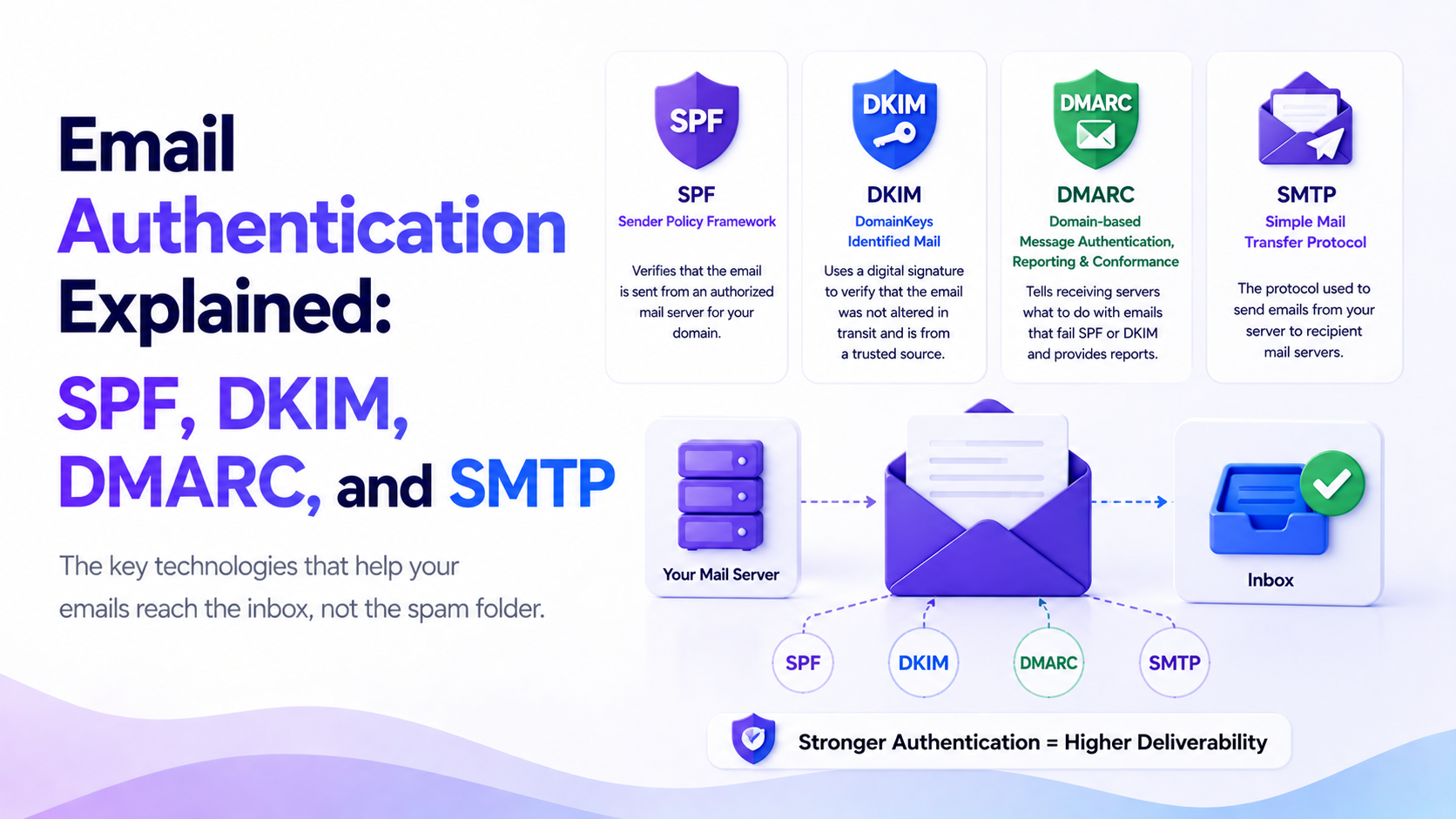
This is where SPF, DKIM, DMARC, and SMTP come into play.
These technologies work together to help email providers determine whether they can trust an email before delivering it to the inbox.
In this guide, we’ll explain what each technology does, why it matters, and how businesses can use them to improve email deliverability and security.
Why Email Authentication Matters
Email was originally designed without strong security mechanisms.
As a result, attackers can easily impersonate domains and send fraudulent emails pretending to come from legitimate organizations.
Without authentication, cybercriminals can:
- Spoof your domain
- Send phishing emails
- Damage your brand reputation
- Reduce customer trust
- Harm email deliverability
Email authentication helps solve these problems by providing proof that emails are being sent from authorized sources.
What Is SMTP?
SMTP (Simple Mail Transfer Protocol) is the standard protocol used to send emails across the internet.
When your website, application, or mail server sends an email, SMTP is responsible for transmitting that message to the recipient’s mail server.
Think of SMTP as the delivery service responsible for transporting the email.
However, SMTP alone does not verify whether the sender is legitimate.
That’s why additional authentication technologies are required.
What Is SPF?
SPF stands for:
Sender Policy Framework
SPF allows domain owners to specify which servers are authorized to send emails on behalf of their domain.
The configuration is stored in your domain’s DNS records.
Example
If your domain is:
example.comYou can create an SPF record that authorizes:
- Your SMTP provider
- Your mail server
- Your marketing platform
When an email arrives, the receiving server checks whether the sending server appears on the authorized list.
If it does, the SPF check passes.
If it does not, the SPF check fails.
Benefits of SPF
SPF helps:
- Prevent unauthorized email sending
- Reduce spoofing attempts
- Improve deliverability
- Increase trust with email providers
However, SPF alone is not sufficient.
What Is DKIM?
DKIM stands for:
DomainKeys Identified Mail
DKIM uses cryptographic signatures to verify that an email has not been altered during transmission.
When an email is sent:
- A digital signature is attached.
- The recipient’s mail server retrieves a public key from DNS.
- The signature is validated.
If the signature matches, the email is considered authentic.
Benefits of DKIM
DKIM helps:
- Verify message integrity
- Prevent tampering
- Improve inbox placement
- Build trust with receiving servers
Many major email providers strongly recommend DKIM implementation.
What Is DMARC?
DMARC stands for:
Domain-based Message Authentication, Reporting & Conformance
DMARC builds on SPF and DKIM.
It tells receiving servers what to do when authentication checks fail.
Possible actions include:
None
Monitor failures but take no action.
Quarantine
Place suspicious emails in the spam folder.
Reject
Block suspicious emails entirely.
Why DMARC Is Important
DMARC helps organizations:
- Prevent domain spoofing
- Stop phishing attacks
- Protect brand reputation
- Improve email security
It also provides reporting that helps businesses identify unauthorized email activity.
How SPF, DKIM, and DMARC Work Together
Think of them as a security team:
SPF
Verifies the sending server.
DKIM
Verifies message integrity.
DMARC
Enforces authentication policies.
Together they create a strong foundation for email trust.
How Authentication Affects Deliverability
Email providers increasingly require authentication.
Without proper configuration:
- Emails may land in spam
- Emails may be rejected
- Domain reputation may suffer
With proper authentication:
- Inbox placement improves
- Trust increases
- Deliverability rises
- Security is strengthened
For many businesses, implementing authentication can significantly improve email performance.
Common Authentication Mistakes
Many organizations unknowingly create deliverability issues through incorrect configurations.
Common mistakes include:
Missing SPF Records
No authorized sending servers are defined.
Multiple SPF Records
Only one SPF record should exist per domain.
Incorrect DKIM Keys
Improper DKIM configuration causes validation failures.
No DMARC Policy
Domains remain vulnerable to spoofing.
Using PHP Mail Without Authentication
Emails lack modern trust signals.
How SMTP Supports Authentication
A professional SMTP service simplifies authentication management.
Most providers help businesses:
- Configure SPF
- Enable DKIM signing
- Implement DMARC policies
- Authenticate email traffic
- Monitor deliverability
This makes it easier to maintain strong email security and inbox placement.
Why Businesses Need Proper Authentication
Organizations that rely on email communication should prioritize authentication.
Examples include:
E-Commerce Stores
- Order confirmations
- Shipping notifications
- Invoices
SaaS Platforms
- Account verification
- Password resets
- Billing alerts
Membership Websites
- Registration emails
- Subscription reminders
Corporate Websites
- Contact form notifications
- Customer communications
Without authentication, these important emails may fail to reach recipients.
Improve Email Deliverability with PLiKhost SMTP Service
Proper authentication is much easier when using professional email infrastructure.
The PLiKhost SMTP Service helps businesses implement modern email delivery best practices, including support for SPF, DKIM, DMARC, and authenticated SMTP delivery.
Whether you’re sending:
- Transactional emails
- Marketing campaigns
- Customer notifications
- E-commerce communications
- Application-generated emails
PLiKhost provides reliable SMTP infrastructure designed to improve deliverability and security.
👉 Learn more here:
https://plikhost.com/smtp-service/
Conclusion
Email authentication has become a critical requirement for modern email delivery.
SPF, DKIM, DMARC, and SMTP each play a unique role in helping businesses improve security, prevent spoofing, and increase inbox placement rates.
Organizations that implement these technologies correctly benefit from stronger sender reputation, improved deliverability, and greater customer trust.
For businesses that depend on email communication, authentication is no longer optional—it is essential.