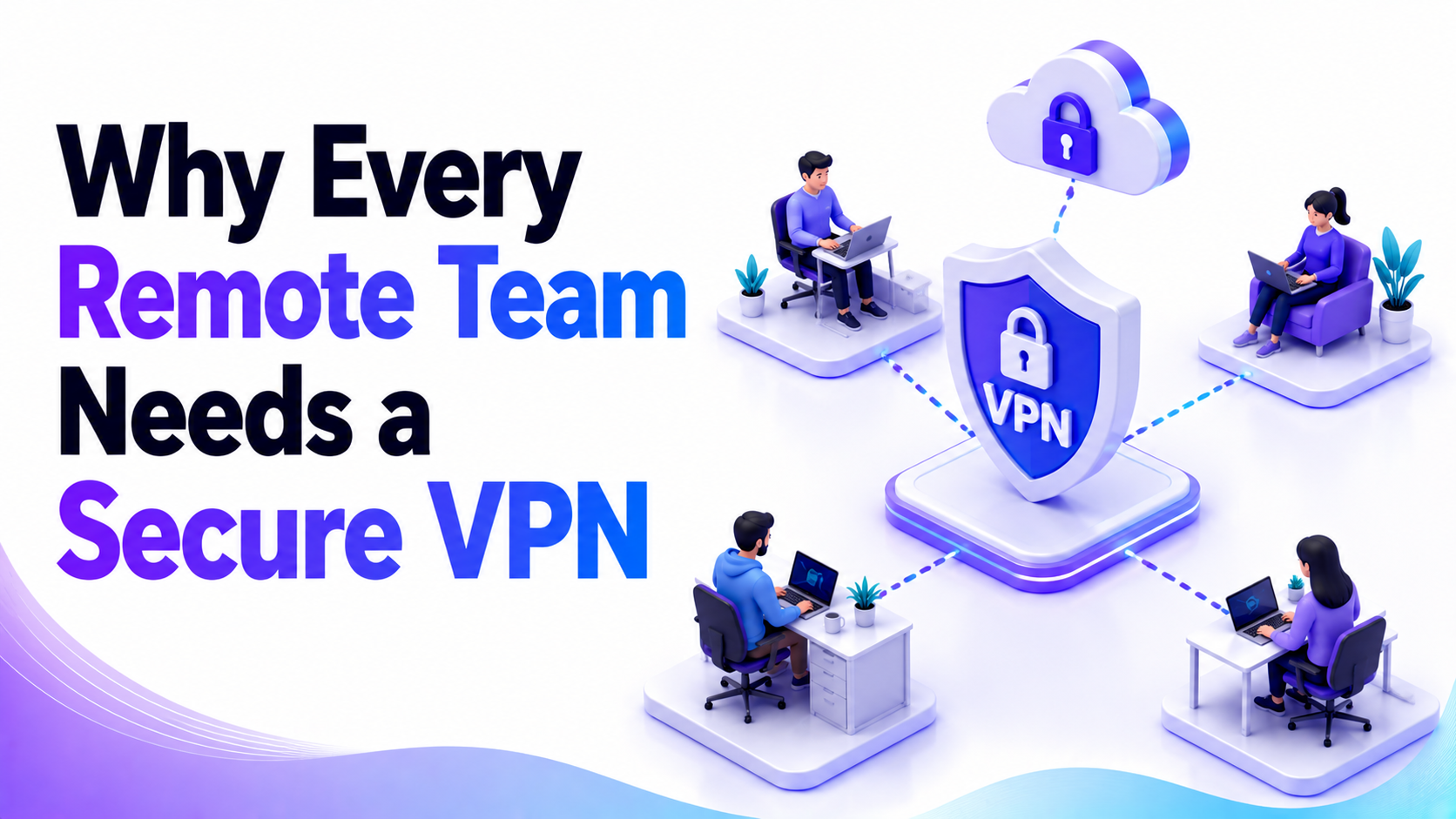
Remote and hybrid work have become standard operating models for businesses around the world. Employees now access company systems from home offices, coworking spaces, client locations, airports, hotels, and other remote environments.
While this flexibility improves productivity and work-life balance, it also introduces new security challenges.
When employees connect to company resources over the public internet, sensitive business data may be exposed to various risks, including cyberattacks, unauthorized access, and data interception.
This is why Virtual Private Networks (VPNs) have become an essential component of modern remote work strategies.
A secure VPN helps protect business communications, safeguard sensitive information, and provide employees with secure access to company resources regardless of location.
In this article, we’ll explain what a VPN is, how it works, and why every remote team should consider using one.
What Is a VPN?
VPN stands for Virtual Private Network.
A VPN creates a secure, encrypted connection between a user’s device and a private network.
Instead of sending data directly across the public internet, the VPN encrypts the traffic and routes it through a secure tunnel.
This helps protect information from unauthorized access while allowing users to access internal resources securely.
How Does a VPN Work?
Without a VPN:
- Data travels across the internet in a less protected manner.
- Public networks may expose traffic to security risks.
- Sensitive information may become vulnerable to interception.
With a VPN:
- Data is encrypted before transmission.
- Communications travel through a secure tunnel.
- Company resources remain protected.
- User activity becomes more secure.
The result is a safer connection between remote employees and business systems.
Why Remote Teams Face Unique Security Risks
Traditional office environments often operate within controlled networks protected by:
- Firewalls
- Access controls
- Network monitoring
- Security policies
Remote workers frequently connect from locations that may not offer the same level of protection.
Examples include:
- Home WiFi networks
- Public WiFi hotspots
- Hotels
- Airports
- Coffee shops
These environments can introduce additional security risks.
Risk #1: Public WiFi Networks
Public WiFi is convenient but often lacks strong security controls.
Examples include:
- Airport WiFi
- Hotel WiFi
- Coffee shop networks
- Conference venue networks
These networks may expose users to:
- Traffic interception
- Fake access points
- Credential theft
- Data snooping
A VPN encrypts traffic, helping reduce these risks.
Risk #2: Unauthorized Access to Business Resources
Remote employees frequently need access to:
- File servers
- Internal applications
- Databases
- Administrative systems
Without secure access controls, these systems may be exposed unnecessarily.
A VPN allows organizations to restrict access to authorized users while maintaining security.
Risk #3: Data Interception
Sensitive business information often travels across the internet.
Examples include:
- Customer records
- Financial information
- Contracts
- Internal communications
Without encryption, attackers may attempt to intercept this information.
VPN encryption helps protect data during transmission.
Risk #4: Compliance and Regulatory Concerns
Many industries must protect sensitive information due to:
- Privacy regulations
- Industry standards
- Customer requirements
A secure VPN can support compliance efforts by improving data protection practices.
While a VPN alone does not guarantee compliance, it contributes to a stronger security posture.
Benefit #1: Secure Remote Access
One of the primary benefits of a VPN is secure access to internal company resources.
Employees can connect safely to:
- Shared files
- Internal systems
- Business applications
- Administrative tools
This allows teams to work effectively from virtually any location.
Benefit #2: Encrypted Communications
Encryption is one of the most important VPN features.
VPNs help protect:
- Login credentials
- Business communications
- Sensitive documents
- Customer information
Even if data is intercepted, encryption makes it significantly more difficult to read.
Benefit #3: Improved Security for Hybrid Work
Many organizations now operate hybrid work models where employees alternate between office and remote environments.
VPNs provide consistent security regardless of location.
Employees can connect securely whether they are:
- At home
- In the office
- Traveling
- Working from client sites
This flexibility supports modern work environments.
Benefit #4: Reduced Risk of Cyberattacks
Cybercriminals frequently target remote workers because home and public networks often have weaker security.
A properly configured VPN helps reduce exposure to:
- Credential theft
- Man-in-the-middle attacks
- Network snooping
- Unauthorized access attempts
While no solution eliminates all risk, VPNs provide an important layer of protection.
Benefit #5: Centralized Access Control
Organizations can use VPNs to manage access more effectively.
Administrators may:
- Control who can connect
- Restrict access to specific resources
- Monitor connection activity
- Revoke access when necessary
Centralized management improves overall security and operational control.
Common VPN Use Cases for Businesses
VPNs support a variety of business scenarios.
Remote Employees
Provide secure access to company resources from home.
Traveling Staff
Protect connections while working from hotels and public networks.
Branch Offices
Secure communication between multiple business locations.
IT Administrators
Enable secure remote management of servers and infrastructure.
Contractors and Consultants
Provide controlled access to required systems.
These use cases make VPNs valuable for organizations of all sizes.
Popular VPN Technologies
Several VPN technologies are commonly used in business environments.
Examples include:
WireGuard
Known for:
- High performance
- Modern encryption
- Simplicity
OpenVPN
Widely used and highly flexible.
IPsec VPN
Often used for site-to-site connectivity.
SSL VPN
Frequently deployed for secure remote user access.
The best choice depends on business requirements and infrastructure.
Common VPN Challenges
Although VPNs provide many benefits, organizations may occasionally encounter challenges such as:
Connection Failures
Authentication or configuration issues.
Slow Performance
Bandwidth limitations or network bottlenecks.
Device Compatibility
Configuration differences across platforms.
User Training
Employees may require guidance on proper usage.
Professional support can help resolve these challenges quickly.
VPN Best Practices
Organizations should follow several best practices when deploying VPN solutions.
Use Strong Authentication
Enable multi-factor authentication whenever possible.
Keep VPN Software Updated
Install updates regularly to maintain security.
Restrict Access
Provide only the access users require.
Monitor Connections
Review VPN activity and investigate unusual behavior.
Train Employees
Help users understand secure remote work practices.
These measures improve both security and usability.
Why Businesses Need Professional VPN Support
VPN deployment and maintenance can become complex, particularly for growing organizations.
Professional support helps with:
- VPN setup
- Configuration management
- Security optimization
- Troubleshooting
- User support
This ensures remote access remains reliable and secure.
Professional Technical Helpdesk & Remote Support from PLiKhost
Secure remote connectivity is essential for modern businesses.
The Technical Helpdesk & Remote Support service from PLiKhost provides professional assistance for VPN deployment, remote access configuration, network troubleshooting, and related IT support needs.
Services include:
- VPN setup and configuration
- Secure remote access support
- Network troubleshooting
- Operating system support
- Connectivity issue resolution
- Performance optimization
- General IT assistance
Whether you need a one-time VPN setup, prepaid support hours, or ongoing monthly assistance, PLiKhost offers expert remote support to help keep your team connected securely.
Learn more here:
https://plikhost.com/technical-helpdesk-remote-support/
Conclusion
As remote and hybrid work continue to grow, securing remote access has become a business necessity.
A VPN helps protect sensitive information, secure employee connections, reduce cybersecurity risks, and provide reliable access to business resources from virtually anywhere.
By implementing a secure VPN strategy and maintaining proper support and management practices, organizations can improve both security and productivity for their remote teams.
For businesses that depend on remote work, a VPN is no longer a luxury—it is an essential part of a modern IT security strategy.