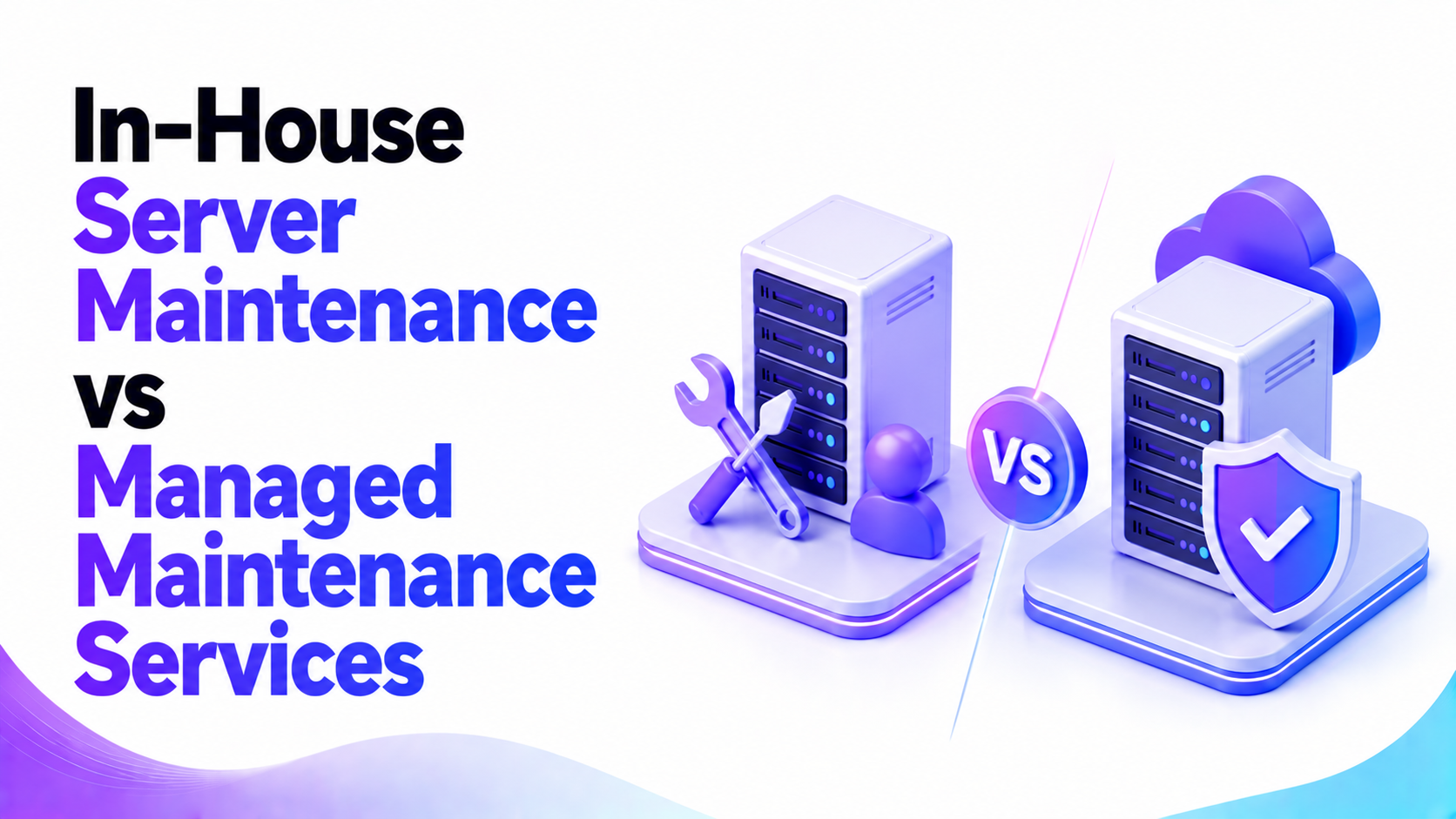
Introduction
Every business that relies on servers faces an important decision:
Should server maintenance be handled internally, or should it be outsourced to a managed maintenance provider?
For small and medium-sized businesses, this decision can significantly impact operational efficiency, security, uptime, and IT costs.
Some organizations prefer to manage everything internally, believing it offers greater control. Others choose managed maintenance services to gain access to specialized expertise and proactive support without hiring additional staff.
The reality is that both approaches have advantages and disadvantages.
The right choice depends on factors such as:
- Business size
- Technical complexity
- Budget
- Internal expertise
- Availability requirements
- Growth plans
In this article, we’ll compare in-house server maintenance and managed maintenance services to help you determine which approach best supports your organization’s goals.
What Is In-House Server Maintenance?
In-house server maintenance refers to managing server infrastructure using internal employees.
Responsibilities typically include:
- Operating system updates
- Security patching
- Performance monitoring
- Backup management
- Troubleshooting
- Security hardening
- Capacity planning
The organization retains full responsibility for maintaining server health and resolving technical issues.
Depending on company size, this may be handled by:
- IT administrators
- System engineers
- Infrastructure teams
- General IT personnel
What Is Managed Server Maintenance?
Managed server maintenance involves outsourcing maintenance activities to a specialized service provider.
The provider performs routine tasks such as:
- Server monitoring
- Security updates
- Performance optimization
- Backup verification
- Health checks
- Incident response
- Maintenance scheduling
The goal is to ensure infrastructure remains secure, stable, and optimized without requiring dedicated internal resources.
Managed maintenance services are often available through:
- Monthly plans
- Service agreements
- Subscription-based support models
Why Server Maintenance Matters
Regardless of who performs the work, server maintenance remains essential.
Servers require ongoing attention because:
- Security threats evolve continuously
- Software updates are released regularly
- Resource usage changes over time
- Hardware eventually degrades
- Applications require optimization
Without maintenance, organizations face increased risk of:
- Downtime
- Security breaches
- Performance issues
- Backup failures
- Business disruption
The real question is not whether maintenance is necessary, but who should manage it.
The Advantages of In-House Server Maintenance
There are situations where maintaining infrastructure internally makes sense.
Greater Direct Control
Internal teams have direct access to systems and can implement changes according to company policies.
Organizations maintain complete control over:
- Infrastructure decisions
- Maintenance schedules
- Security policies
- Operational procedures
This level of control may be important for certain industries.
Familiarity With Internal Systems
Internal staff often understand business-specific applications and workflows better than external providers.
They may have direct knowledge of:
- Legacy applications
- Custom integrations
- Internal processes
- Business priorities
This familiarity can sometimes accelerate troubleshooting.
Immediate Access to Internal Resources
In-house teams are already integrated into company operations.
Communication may be simpler because staff members work within the same organization.
The Challenges of In-House Server Maintenance
Despite these advantages, internal maintenance presents several challenges.
Staffing Costs
Hiring experienced server administrators can be expensive.
Organizations must consider:
- Salaries
- Benefits
- Training
- Certifications
- Recruitment costs
For many businesses, maintaining a dedicated infrastructure team may not be financially practical.
Limited Availability
Internal staff typically work standard business hours.
Server issues, however, do not follow office schedules.
Problems may occur:
- Overnight
- During weekends
- On holidays
Limited availability can increase downtime.
Skill Gaps
Modern infrastructure requires expertise across multiple areas:
- Linux administration
- Windows administration
- Security
- Networking
- Backup systems
- Performance optimization
Finding one individual who excels in all areas can be difficult.
Operational Dependency
Organizations may become dependent on specific employees.
If key personnel leave, infrastructure knowledge may leave with them.
The Advantages of Managed Maintenance Services
Managed maintenance services address many of the challenges associated with internal administration.
Access to Specialized Expertise
Managed providers often maintain teams with expertise in:
- Server administration
- Security
- Monitoring
- Backup management
- Performance tuning
Businesses gain access to broader knowledge without hiring multiple specialists.
Proactive Monitoring
Most managed services include ongoing monitoring.
This allows providers to identify:
- Resource issues
- Security concerns
- Backup failures
- Performance bottlenecks
before they become critical problems.
Predictable Costs
Managed maintenance typically operates under fixed monthly pricing.
This improves budgeting and reduces unexpected support expenses.
Improved Availability
Many providers offer extended support coverage.
This may include:
- After-hours monitoring
- Weekend support
- Emergency response
This improves operational resilience.
Security Benefits of Managed Maintenance
Cybersecurity is one of the strongest arguments for professional maintenance services.
Managed providers typically handle:
Security Updates
Regular patch management reduces vulnerability exposure.
Security Hardening
Systems are configured according to security best practices.
Vulnerability Reviews
Potential risks are identified proactively.
Backup Verification
Recovery readiness is continuously evaluated.
For many businesses, this level of oversight is difficult to achieve internally.
Performance Benefits of Managed Maintenance
Performance issues often develop gradually.
Managed maintenance providers regularly review:
- CPU utilization
- Memory consumption
- Storage performance
- System load
- Database efficiency
These reviews help ensure infrastructure remains optimized.
Benefits may include:
- Faster websites
- Better application performance
- Reduced downtime
- Improved user experience
Comparing Costs
One of the most common questions businesses ask is:
Which option is more cost-effective?
In-House Costs
Typical expenses include:
- Salaries
- Employee benefits
- Training
- Certifications
- Recruitment
- Management overhead
These costs often exceed expectations.
Managed Maintenance Costs
Managed services generally provide:
- Predictable monthly pricing
- Shared expertise
- Proactive maintenance
- Ongoing monitoring
For many small and medium-sized businesses, managed maintenance offers better value.
Which Businesses Benefit Most from Managed Maintenance?
Managed services are particularly valuable for:
Small Businesses
Organizations without dedicated infrastructure teams.
Growing Companies
Businesses scaling rapidly and requiring additional expertise.
E-Commerce Platforms
Websites where uptime directly affects revenue.
SaaS Providers
Applications that require consistent performance and availability.
Organizations with Limited IT Resources
Companies seeking enterprise-level support without enterprise-level staffing costs.
Situations Where In-House Maintenance May Be Appropriate
Internal maintenance may still be suitable for:
Large Enterprises
Organizations with dedicated infrastructure teams.
Highly Customized Environments
Systems requiring deep internal knowledge.
Regulated Industries
Businesses with strict operational requirements.
Even in these situations, organizations often supplement internal teams with managed services.
Hybrid Approaches
Many businesses adopt a hybrid model.
Internal staff focus on:
- Strategic projects
- Business-specific applications
- User support
Managed providers handle:
- Monitoring
- Maintenance
- Security updates
- Backup verification
- Performance reviews
This approach combines internal knowledge with external expertise.
Calculating Return on Investment
When evaluating maintenance strategies, businesses should consider:
Downtime Reduction
Proactive maintenance often prevents costly outages.
Improved Productivity
Optimized systems improve employee efficiency.
Better Security
Reduced risk of security incidents.
Lower Staffing Costs
Organizations avoid hiring additional specialists.
Scalability
Infrastructure support grows alongside business needs.
These benefits frequently justify managed maintenance investments.
Why Businesses Are Moving Toward Managed Maintenance
Technology environments have become increasingly complex.
Today’s servers often involve:
- Cloud services
- Virtualization
- Security platforms
- Backup systems
- Hybrid infrastructure
Maintaining expertise across all areas internally can be challenging.
Managed maintenance providers offer a practical solution by delivering specialized support and proactive management.
Routine System Maintenance from PLiKhost
PLiKhost’s Routine System Maintenance service provides proactive server care designed to improve security, performance, and reliability while reducing operational burden.
Services include:
- OS and security updates
- Server health monitoring
- Backup verification
- Performance optimization
- Security hardening
- Weekly maintenance reviews
- Scheduled maintenance
Whether you’re replacing internal maintenance efforts or supplementing an existing IT team, PLiKhost helps ensure your infrastructure remains secure and stable.
Learn more:
https://plikhost.com/routine-system-maintenance/
Related services:
Frequently Asked Questions
What is managed server maintenance?
Managed server maintenance is a service where a specialized provider handles server updates, monitoring, optimization, security, and maintenance tasks on behalf of a business.
Is managed maintenance cheaper than hiring an administrator?
For many small and medium-sized businesses, managed maintenance is significantly more cost-effective than hiring full-time infrastructure specialists.
Does managed maintenance improve security?
Yes. Most providers include patch management, security reviews, vulnerability assessments, and backup verification.
Can managed services reduce downtime?
Absolutely. Proactive monitoring and maintenance often prevent issues before they cause outages.
Is managed maintenance suitable for small businesses?
Yes. Small businesses frequently benefit because they gain enterprise-level expertise without expanding internal staffing.
Can managed maintenance work alongside internal IT teams?
Yes. Many organizations use a hybrid approach where internal staff handle business-specific tasks while managed providers oversee infrastructure maintenance.
Recommended External Resources
- CISA Cybersecurity Resources: https://www.cisa.gov
- NIST Cybersecurity Framework: https://www.nist.gov/cyberframework
- Microsoft Learn Infrastructure Management: https://learn.microsoft.com
- Cloudflare Learning Center: https://www.cloudflare.com/learning/