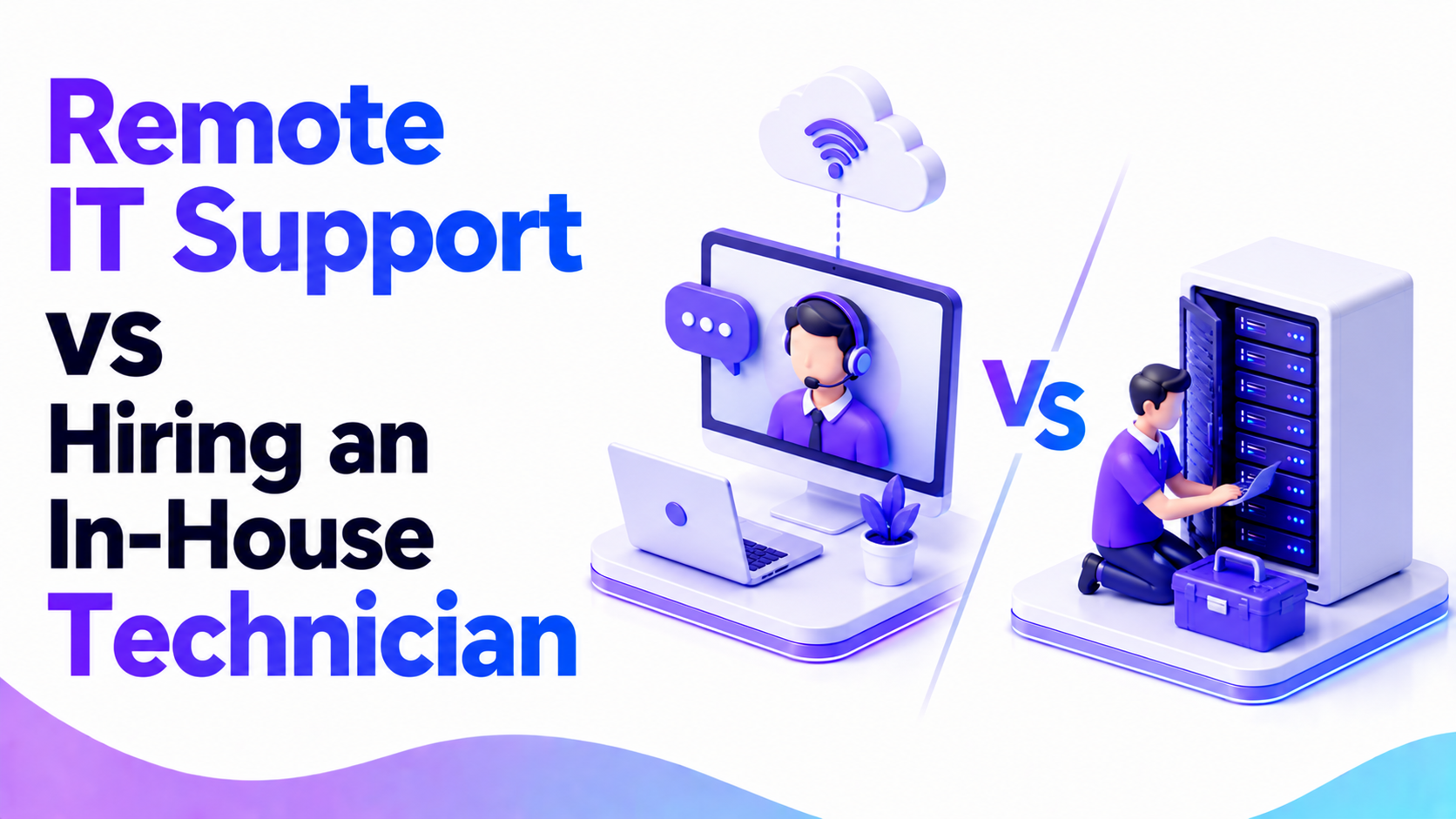
Choosing the right IT support for your business is one of the most practical decisions a growing company will face. From communication and collaboration to customer service and daily workflows, every organization needs fast, reliable technical help to stay productive and competitive.
The question most business owners eventually ask is: should we hire an in-house technician, or use a managed remote support service? Both approaches deliver real value — but they differ significantly in cost, flexibility, expertise, and scalability.
According to Clutch’s SMB IT survey, nearly 37% of small businesses now outsource at least one IT function, citing cost savings and access to specialized expertise as the top two reasons. Let’s break down why — and help you decide which model fits your business best.
Understanding In-House IT Support
An in-house technician is a dedicated employee who manages and supports your organization’s technology infrastructure directly.
Typical responsibilities include computer troubleshooting, network management, software installation, user support, security maintenance, and hardware management. The technician works on-site and is usually available during business hours — which gives some organizations a sense of control and immediate access when things go wrong.
Understanding Remote Technical Support
A managed support provider gives your business access to professional technical assistance without maintaining a full-time internal employee.
Using secure remote access tools, technicians can diagnose issues, configure systems, troubleshoot software, resolve connectivity problems, and perform routine maintenance — all without stepping foot in your office. Providers typically serve multiple clients and offer flexible plans tailored to different needs and budgets.
Cost Comparison
For most organizations, cost is the deciding factor.
Hiring an in-house employee involves far more than salary alone. Additional expenses include benefits, insurance, training, equipment, recruitment costs, and management overhead. For small businesses, this can represent a significant ongoing investment.
Managed support services, on the other hand, typically offer pay-per-incident plans, hourly support, or monthly packages. You pay only for what you actually use — which often results in substantially lower overall spending.
Winner: Managed Remote Support
For most small and medium-sized businesses, outsourced IT support for business delivers greater cost efficiency than maintaining internal staff.
Access to Expertise
Modern technology environments span operating systems, cloud services, VPNs, networking, security systems, and business applications. A single in-house technician may excel in certain areas but struggle with others — and complex issues sometimes require outside help regardless.
Remote support providers, by contrast, typically employ multiple specialists across diverse technology domains. This gives your business access to broader expertise without the cost of hiring a full team.
Winner: Managed Remote Support
Broader knowledge base, without additional headcount.
Response Time
Fast resolution is critical for minimizing downtime. An internal technician can respond immediately — when available. However, vacation, sick leave, meetings, or multiple simultaneous issues can all affect availability.
Remote technicians can often begin troubleshooting within minutes, and many issues are resolved without waiting for an on-site visit. However, coverage gaps can still occur depending on the provider’s support hours.
Winner: Tie
Both options can offer rapid response, depending on circumstances and provider quality.
Scalability
As your company grows, a single technician may struggle to keep pace with increasing demands. You’d eventually need additional staff, specialized expertise, or expanded resources — all of which add cost and complexity.
Managed IT support for business scales with you. Support plans adjust as your requirements evolve, without major staffing changes or recruitment cycles.
Winner: Managed Remote Support
Greater flexibility as your business grows.
Availability
Technical issues don’t follow business hours. Internal IT staff typically work standard schedules, leaving after-hours coverage limited or non-existent.
Many managed support providers offer extended availability and flexible arrangements — so you can access assistance when you actually need it, not just when someone happens to be in the office.
Winner: Managed Remote Support
Better coverage, especially for distributed or hybrid teams.
Hardware Support
There are situations where physical presence is genuinely necessary — hardware replacement, cabling, equipment deployment, or physical repairs. An in-house technician handles these immediately, while a remote provider may need to coordinate with local staff or third-party vendors.
Winner: In-House Technician
Physical tasks require physical presence.
Security and Maintenance
Maintaining secure systems requires consistent attention: software updates, patches, user management, access control, and performance monitoring. In-house security quality depends heavily on the individual’s experience and current workload.
Managed providers typically follow established procedures and best practices across multiple environments — however, quality still varies by provider, so due diligence matters.
Winner: Depends on Provider Quality
Both approaches can be effective when managed properly.
Which Businesses Benefit Most from In-House IT?
Internal staff makes sense for organizations that have hundreds of employees, operate complex physical infrastructure, require constant on-site support, or manage large hardware environments. Larger enterprises with dedicated budgets often justify the investment.
Which Businesses Benefit Most from Managed IT Support?
Flexible IT support for business is typically the smarter choice for:
- Small businesses — professional support without full-time hiring costs
- Startups — control costs while maintaining technical reliability
- Branch offices — coverage without local IT personnel
- Remote and hybrid teams — support regardless of user location
- Growing organizations — scale services as requirements evolve
For many companies, this model delivers an excellent balance of cost, coverage, and capability.
Common Misconceptions Worth Addressing
“Remote technicians can’t solve complex problems.”
In reality, many advanced issues are diagnosed and resolved entirely remotely — often faster than waiting for an on-site visit.
“Remote support is less secure.”
Professional providers use encrypted remote access tools and follow strict security procedures.
“We need someone on-site every day.”
Most businesses discover that the vast majority of support requests are resolved without anyone physically present.
Why Some Businesses Choose a Hybrid Approach
Many organizations combine both models — internal staff handle daily operations, while remote specialists provide advanced support and after-hours coverage. As a result, this hybrid approach offers flexibility while maintaining access to deeper expertise when it matters most.
Professional IT Support for Business from PLiKhost
Not every business needs a full-time IT department. PLiKhost’s Technical Helpdesk & Remote Support provides fast, professional assistance for common IT challenges — without the cost of hiring dedicated internal staff.
Services include email account support, software troubleshooting, operating system assistance, VPN setup, network and WiFi troubleshooting, printer and scanner support, device optimization, and system updates.
Whether you need a one-time fix, prepaid support hours, or ongoing monthly assistance, PLiKhost offers flexible plans designed to keep your business productive.
Conclusion
Both in-house technicians and managed providers can deliver strong IT support for business — but they serve very different needs. In-house staff suits larger organizations with extensive on-site requirements. Managed remote support offers better cost efficiency, flexibility, scalability, and expertise access for most small and medium-sized businesses.
Furthermore, as technology continues to evolve and remote work becomes standard, managed support is increasingly becoming the default choice for modern organizations that want to stay productive without overspending on internal resources.
🟢 Explore PLiKhost Technical Helpdesk & Remote Support — professional IT support for your business, on your terms.